Recently, we were flying back from Kolkata after delivering a workshop. The Air India flight was ready for take-off. Three of us settled into our seats, each choosing our own way to unwind – one plugged into music, another opened a book, and the third, exhausted, decided to take a quick nap.
Soon, the cabin announcement followed: “We will be serving food shortly.”
The cabin crew reached our row and politely asked, “Veg or non-veg?”
After sharing our preferences, I casually joked, “Don’t you have butter chicken and lachha paratha?”
He smiled and replied, “I wish! I would have loved that too.”
That one line opened the door.
What started as a light comment soon turned into a conversation – about whether we were travelling for work, which cities we lived in, how often we flew. Our boss, seated nearby, overheard us and joined in. He asked the crew member about his career, aspirations, working hours, and experiences. After a brief but warm exchange, the crew member moved on to serve others.
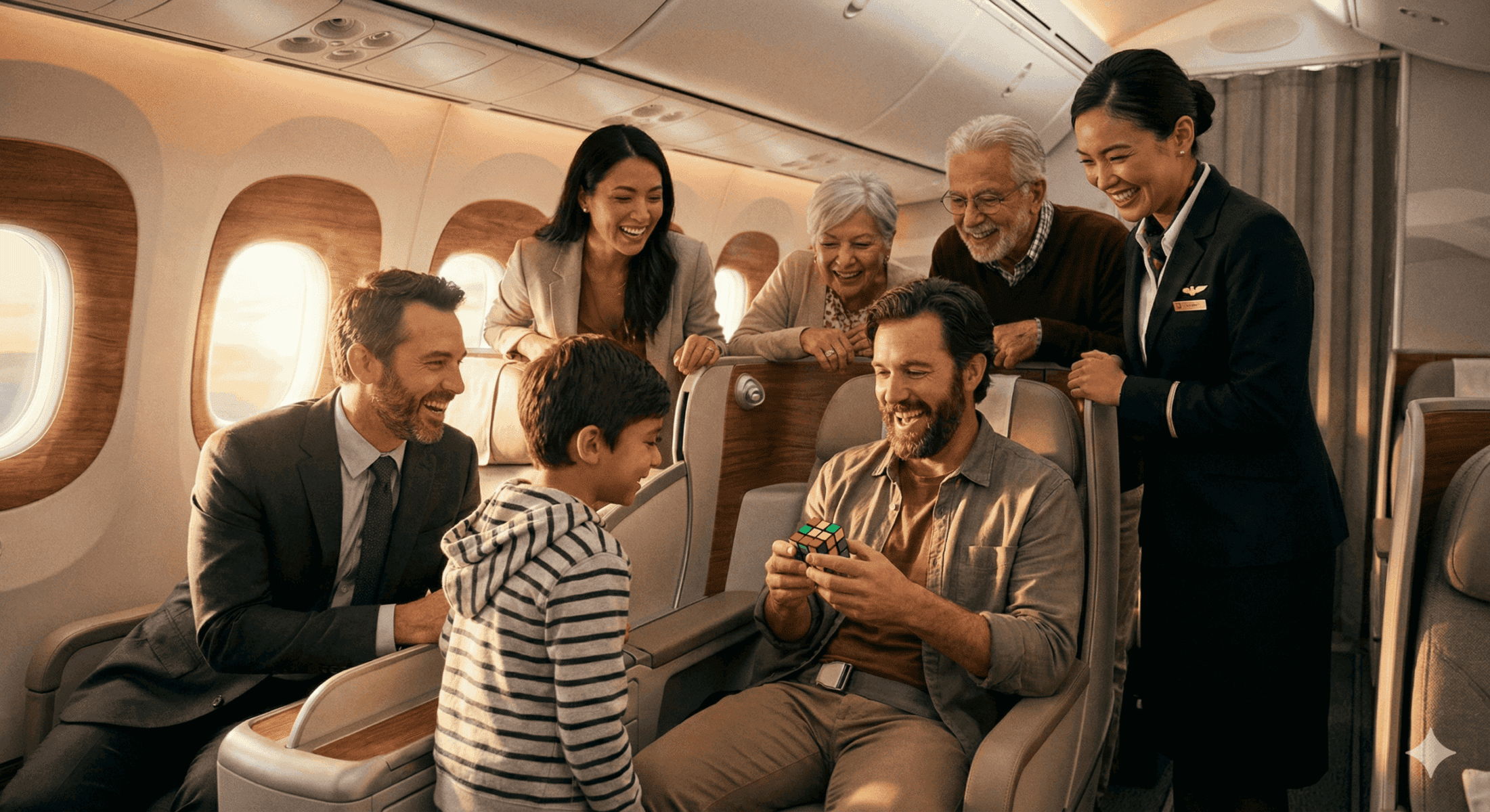
A few minutes later, our boss pulled out a Rubik’s Cube and casually challenged us to solve it.
We tried. And failed. Repeatedly.
Next to us sat a young boy, quietly watching our unsuccessful attempts. One of my colleagues finally asked, “Can you solve this for us?”
The boy looked at his mother. She smiled and asked him, “Will you?”
Before he could respond, the same cabin crew member passed by again, noticed what was happening, and joined in with a grin: “Please solve it for them… their appraisal depends on this.”
Everyone laughed.
Within minutes, six or seven of us – passengers, a child, a cabin crew member – were fully engaged, discussing patterns, turning cubes, failing, learning, laughing. A group of strangers, connected over a simple puzzle.
The Hidden Value of Small Talk in Building Rapport
So, what really happened here?
And why am I sharing this story?
Because this is the power of small talk.
A simple comment. A genuine question. A light-hearted moment. Small talk isn’t meaningless – it’s the bridge to meaningful connection. Saying good morning with intent. Asking how someone’s breakfast was. Sharing a smile. These moments open doors we don’t even realize exist, and they perfectly illustrate why trust matters when building strong interpersonal foundations
Enhancing Corporate Training Through Experiential Learning
The same principle applies to the workshops we deliver.
Our sessions are designed around the experiential learning cycle – experience first, then reflection, application, and parallels to real work life. But we don’t jump straight into content and agendas.
We begin with something simple, yet powerful: Name Tags.
Participants write their names – but with a twist. Instead of just their designation, they add something personal: their favourite cartoon character, dish, movie, or hobby. Then they share the why behind it.
Creating Psychological Safety and Team Engagement
And magic happens.
Stories emerge. Laughter follows. People relate. This shared lightheartedness is a great reminder of why so serious: how positivity at the workplace attracts success. Connections form – quickly and organically. Those name tags often stay with participants far beyond the workshop: for days, weeks, sometimes even for life
For facilitators, this creates an instant bridge. We can relate better, empathize more deeply, and even have light banter. Participants shed their inhibitions without realizing it. The room feels safer. Learning becomes easier, richer, and far more engaging.
So, is small talk a waste of time?
Not at all.
Sometimes, it’s the very thing that turns strangers into collaborators, offering one of the most organic methods for how to break silos within an organisation. It transforms workshops into experiences, and moments into memories.