I used to be a firm believer in the “big event” theory of corporate training. If we had a problem, I would solve it with a workshop. We once spent a fortune on a two-day, offsite “Advanced Communication Skills” program for our new managers. We brought in a top tier facilitator, the binders were glossy, and the feedback was fantastic. Everyone loved it.
Then, I sat in on one of the manager’s team meetings a month later. It was a disaster. The manager was using the same poor communication habits we had just spent two days trying to fix. The expensive binders were gathering dust, and the skills had evaporated into thin air. It was a classic case of “learning transfer” failure. The knowledge never made the journey from the workshop to the workplace. I was frustrated, my budget was wasted, and I was starting to think our entire approach to training was broken.
That failure sent me down a rabbit hole of research, which is where I first encountered the term “microlearning.” Initially, I was skeptical. It sounded like another L&D buzzword, a gimmick promising a quick fix. But the more I dug in, the more I realized it was not a gimmick at all. It was a fundamentally different and smarter way to think about learning. And it was the perfect solution to my biggest problem.
So, What is Microlearning, Really? (Beyond the Buzzword)

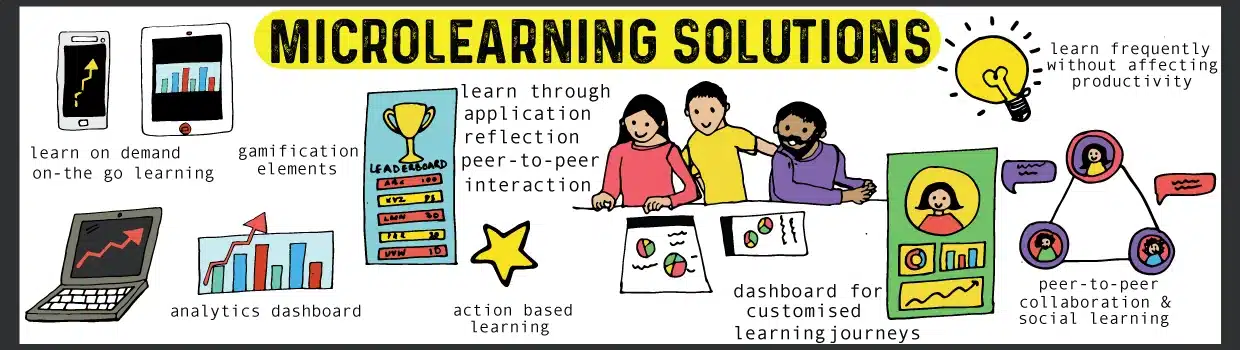
At its core, microlearning is simple. It is the practice of delivering learning content in small, highly focused, bite sized chunks. The key principles are:
- It’s Short: A piece of microlearning content is typically consumed in under 5 minutes.
- It’s Focused: Each piece is designed to teach one, and only one, specific learning objective. Not “Communication Skills,” but “How to Give Constructive Feedback Using the SBI Model.”
- It’s Accessible: It is usually designed for on demand access, often on a mobile device, so the learner can get to it at their precise moment of need.
It is not just about making shorter videos. It is a complete philosophy that respects the learner’s time, aligns with how our brains actually work, and treats learning not as a one time event, but as a continuous process.
Also read: Micro-learning: Learning in Small Bites
The “Aha!” Moment: Why Microlearning Works, According to Science
My skepticism faded when I understood the cognitive science behind why microlearning is so effective. It is designed to work with our brains, not against them.
- It Fights the Forgetting Curve: In the 19th century, psychologist Hermann Ebbinghaus discovered the “Forgetting Curve,” which shows that we forget a huge percentage of what we learn within 24 hours if the knowledge is not reinforced. Microlearning is the ultimate weapon against this. By delivering small, repeated doses of information over time (a concept called spaced repetition), it forces the knowledge into our long term memory.
- It Respects Our Attention Spans: We live in a world of constant distraction. Our ability to focus for long, unbroken periods has diminished. Microlearning acknowledges this reality. By keeping the content short and hyper relevant, it has a much better chance of capturing and holding the learner’s full attention.
- It Reduces Cognitive Load: Our working memory, the part of our brain that processes new information, has a limited capacity. A traditional, multi hour workshop can easily overwhelm it, leading to cognitive overload where very little is retained. Microlearning delivers information in a way that is easy for the brain to process and encode.
What Does it Look Like in Practice? 5 Real-World Examples
Microlearning is not just one thing; it’s a flexible approach that can take many forms.
1. Short Explainer Videos: A 3 minute animated video that explains a single concept, like “What is psychological safety?”
2. Interactive Quizzes: A quick, 5 question quiz sent out a week after a sales training to reinforce key product features.
3. Infographics and Job Aids: A one page, beautifully designed infographic that a manager can pull up on their phone seconds before a one on one meeting, reminding them of the key coaching questions to ask.
4. Gamified Challenges: A daily “mission” sent via an app, where employees earn points for completing a small task related to a new company value.
5. Podcast Snippets: A 4 minute audio clip from an interview with a senior leader, sharing a personal story about how they handled a difficult client.
Also read: How can Gamification be used as a learning tool for your organisation?
The Expert’s View: When Not to Use Microlearning
This is the crucial part that the hype often misses. Microlearning is a powerful tool, but it is not a silver bullet. It is not the right solution for every learning need.
- Do not use it for complex, foundational skills: You cannot learn to be a great public speaker or a strategic leader in 3 minute videos. These complex competencies require deep, immersive, and often in person practice and feedback. Microlearning is a poor substitute for this kind of “macro” learning.
- Do not use it to change deep-seated cultural issues: If you have a toxic culture, a series of short videos on “respect” will do absolutely nothing. Deep cultural change requires intensive leadership intervention and systemic changes.
- Do not use it for initial discovery: Microlearning is most powerful for reinforcing knowledge that has already been introduced. It is less effective for teaching a completely new and complex topic from scratch.
Your First Micro-Project: A 4-Step Guide to Getting Started
Feeling convinced? Getting started is easier than you think.
1. Identify a “Point of Failure”: Find a single, specific breakdown point in your current workflow. For me, it was that my managers were not giving good feedback.
2. Define a Single, Behavioral Objective: Do not be vague. Your objective should be “The manager will be able to deliver feedback using the Situation-Behavior-Impact (SBI) model.”
3. Choose the Right Format: For the SBI model, a simple, one page infographic that a manager can keep on their desktop would be perfect. It is a “just in time” job aid.
4. Create and Distribute: Design the infographic. Then, instead of just sending it out, introduce it in your next team meeting. Explain the “why” behind it, and ask for a commitment from your managers to try using it in their next one on one.
The Right Tool for the Job
I used to think of training as a hammer, and every problem as a nail. My big, expensive workshops were my only tool. The failure of that communication program taught me that a modern L&D professional needs a full toolkit.
Microlearning is not a replacement for deep, immersive learning experiences. But it is the perfect tool for ensuring that the learning from those experiences actually sticks. It is the bridge that carries knowledge from the classroom to the real world. It turned my biggest training problem into our greatest success, not by being a gimmick, but by being a smarter, more human-centered way to learn.
If you’re ready to move beyond the one-off workshop and build a continuous learning culture, explore how FocusU uses microlearning and gamification to create learning that sticks.
About the author