
Working Across Cultures
Because effective collaboration across cultures depends on making the invisible visible.
When colleagues from different nationalities, regions, or organisational cultures work together, friction rarely begins with bad intent.
It often begins with different defaults.
What does “tomorrow” mean?
How direct should feedback be?
When should disagreement be voiced?
Who decides, and who needs to align?
How much context is enough?
The Working Across Cultures intervention helps teams surface these invisible defaults and build practical working agreements for smoother collaboration.


When Organisations Call Us
Organisations typically explore this work when:
- Cross-cultural teams are experiencing recurring friction or misalignment.
- Collaboration feels effortful, even when relationships are cordial.
- Teams working across countries need clearer shared ways of working.
- A merger, expansion, or partnership requires different cultures to work closely together.
- Leaders want to address misunderstanding before it hardens into conflict.
Often, the issue is not the culture gap itself, but the absence of a shared language to name it and a process to work through it together.
Why Working Across Cultures Is Different
This is not a lecture on national cultures, sensitivity training, or a stereotyping exercise.
It is a visual, experiential process that helps teams:
- Surface their own working defaults without judgment
- Understand how the same situation may be interpreted differently
- Distinguish between cultural patterns and individual preferences
- Convert insight into practical working agreements
A well-held process creates the conditions for faster trust, healthier collaboration, and fewer costly misunderstandings.

Our Lens on Working Across Cultures
Our approach is grounded in a few core beliefs:
Culture is not a label. It is a set of learned defaults.
Most friction is caused not by bad intent, but by unspoken expectations.
Cross-cultural collaboration is not about one side adapting to the other.
Teams work better when they co-create shared ways of working.
We draw from well-established culture frameworks, including Erin Meyer’s Culture Map.
But we do not use a fixed template for every group.
The goal is not to teach a model. The goal is to help teams decode the defaults most affecting their work.

How a Session Typically Unfolds
Every engagement is tailored to the cultures involved and the nature of the collaboration, but most follow a deliberate arc:
We map the friction points and moments that matter, such as time, communication, feedback, decision-making, ownership, escalation, or trust.
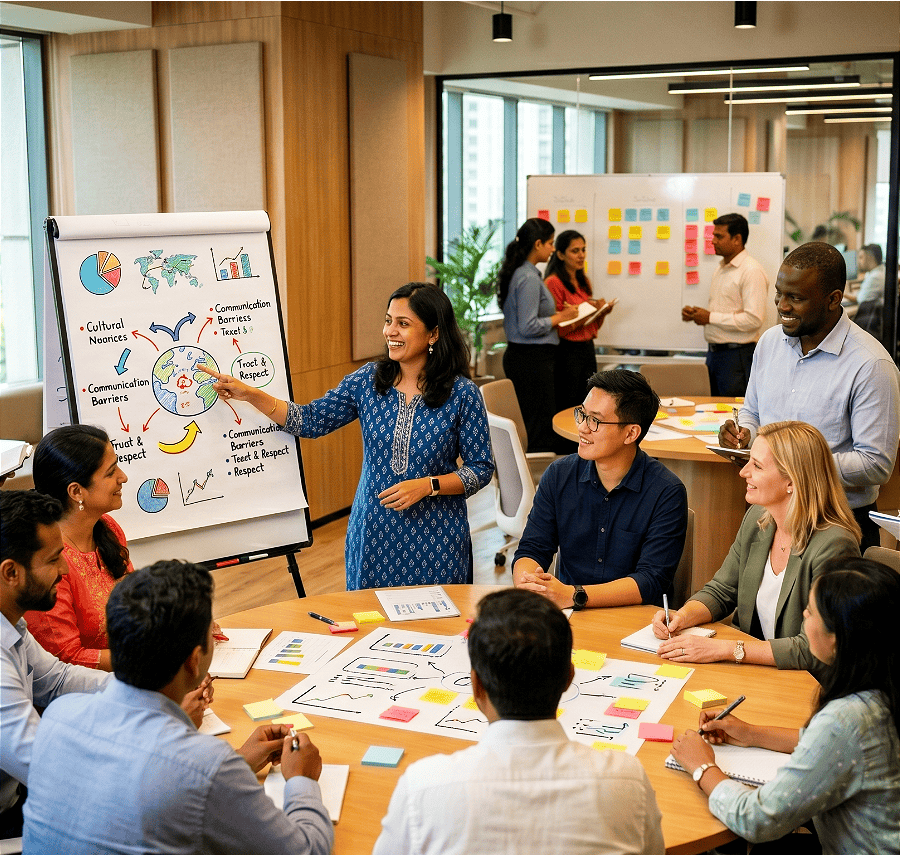
Participants use experiential activities, visual prompts, and workplace scenarios to notice how they interpret everyday situations.
The team explores how different cultural lenses can create misreads, even when intent is positive.
The group co-creates practical working norms around the areas that matter most to their collaboration.
These may include deadlines, meetings, feedback, disagreement, decisions, escalation, ownership, or follow-through.
Each participant identifies one behaviour to shift immediately.
Small, visible behaviour changes help the new agreements come alive beyond the workshop.
Working across cultures is not a one-time event.
It is the beginning of a shared language.
What This Enables Over Time
When teams invest in deliberate cross-cultural alignment, organisations begin to see:
- Fewer recurring friction points and misread intentions.
- Faster trust between colleagues from different backgrounds.
- More honest, productive conversations across disagreement.
- Better execution because assumptions are checked earlier.
Most importantly, teams build a shared vocabulary for naming and navigating differences as they arise.

Where this work is most valuable
Working Across Cultures is especially valuable:
- For newly formed global or cross-cultural teams.
- When Indian teams work closely with colleagues, clients, or leaders in other geographies.
- When a merger, acquisition, or partnership requires different cultures to integrate.
- After friction has surfaced and the team needs a structured reset.
- When leaders want to build inclusive, high-performing collaboration across borders.
How We Hold The Work
Our Culture & OD engagements are guided by a simple principle:
creating SPACE for teams to think, speak, and choose together.
-
S
Safety
Creating a safe space to speak honestly even when conversations are difficult
-
P
Presence
Staying attentive to what is happening in the room, both spoken and unspoken
-
A
Authentic Dialogue
Encouraging open conversations that surface real perspectives and tensions
-
C
Choice
Allowing direction to emerge through shared sensemaking & not prescription
-
E
Enabling Tools
Using methods & tools only when they serve the moment and the context

Stories of Cultural Shift
Across organisations, this work has helped teams:
- Name recurring friction without blame or defensiveness.
- Replace cultural misreads with shared working agreements.
- Build trust between colleagues who had been talking past each other.
- Clarify expectations around deadlines, feedback, disagreement, decisions, and ownership.
- Move from cultural awareness to everyday integration.
In one cross-cultural engagement, the visible issue was time. The hidden issue was meaning.
Words like “tomorrow,” “try,” and “almost done” were creating different interpretations across the group. By the end of the session, the team had co-created a practical collaboration charter for how they would work together going forward.
Frequently asked questions
Don’t see an answer to your question?
Drop us an email and we will get back

Not exactly. Sensitivity training focuses on awareness and respect. This work goes further. It helps teams understand the specific defaults affecting their collaboration and build practical agreements to work better together.
This is a real risk, and one we design against deliberately. The work focuses on cultural patterns while consistently recognising individual variation. The goal is understanding, not labelling.
No. The dimensions are chosen based on the team’s context. One team may need to focus on time, feedback, and decisions. Another may need to focus on hierarchy, trust, or persuasion.
Team-building builds connection and energy. Working Across Cultures builds operational clarity: how the team communicates, decides, disagrees, gives feedback, and follows through.
No. Nationality is one form of culture. Functions, organisations, regions, professional backgrounds, and client-vendor relationships also carry their own norms and invisible rules.
Let’s Begin with a
Conversation
If your cross-cultural team is working hard but experiencing friction that skill alone will not fix, it may be time to make the invisible visible.
Let’s explore what this could look like for your team.