
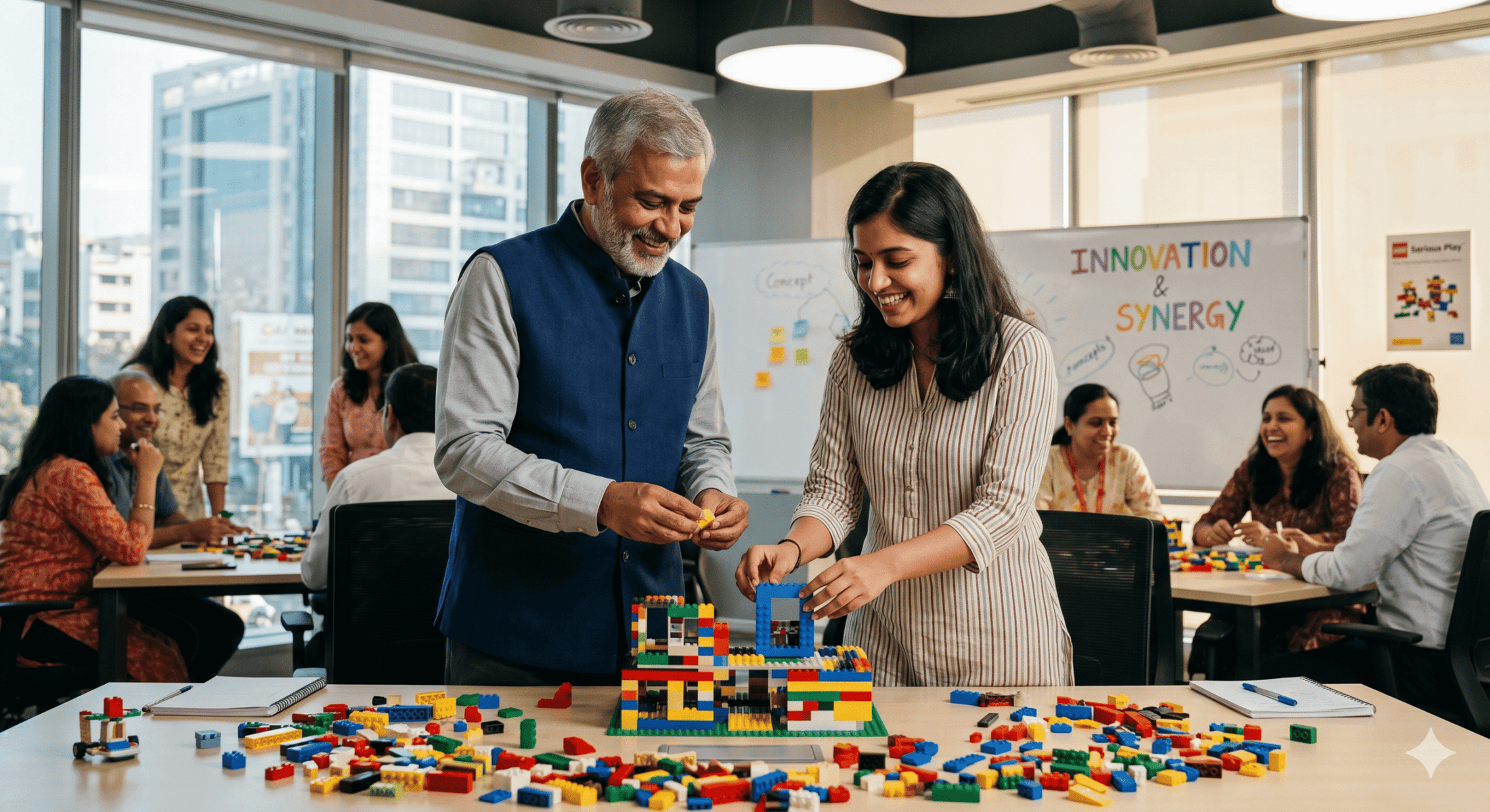
LEGO® Serious Play® (LSP) – Defined
A structured facilitation methodology in which participants use LEGO® bricks to build physical models representing their ideas, strategies, and challenges – and then share the stories behind what they’ve built.
Developed at the LEGO Group in collaboration with professors Johan Roos and Bart Victor · Made open-source in 2010
That definition is accurate, but it understates what makes Lego LSP genuinely different from everything else in the corporate facilitation world. The bricks are not the point. The point is what happens to thinking and communication when ideas become physical objects that sit on the table between people.
While some people initially assume the methodology is simply a form of lego creative play, the reality is very different. The building process is deliberately structured to unlock deeper thinking, surface assumptions, and create meaningful business conversations.
In a conventional strategy meeting, ideas live in heads and on slides. You can’t pick them up. You can’t examine them from different angles. You can’t connect them visually to other people’s ideas. And crucially, when a senior person speaks, everyone else waits, agrees, or carefully disagrees in ways that protect the relationship more than the truth.
LEGO Serious Play changes the architecture of group thinking. When every person builds a model and every model gets shared – regardless of who built it – the quality and honesty of what emerges in the room shifts significantly. This is not a hypothesis. It is the methodologically designed outcome of a rigorous framework developed over two decades. You can see how FocusU designs and delivers LEGO® Serious Play® sessions for corporate teams in India for a concrete sense of what this looks like in practice.
This is the essence of what LSP lego is about. Everything else – the bricks, the sessions, the shared models, the visual output decks – is in service of this core insight.
Origins & History: Who Invented LEGO Serious Play – and Why
The story of LSP is worth knowing, because it explains why the methodology works the way it does – and why it’s grounded in real research, not management trend.
1990s
The Concept is Born at IMD, Switzerland
Professors Johan Roos and Bart Victor at IMD Business School develop the “Serious Play” concept while working with leadership teams. Their core question: how do you help senior managers surface and challenge their own assumptions about strategy? Their answer involves making thinking physical and tangible – not abstract and verbal.
1998
The LEGO Group Adopts the Methodology
LEGO owner Kjeld Kirk Kristiansen sponsors the development of a commercial application. The methodology is tested in real-time sessions with companies including Tetra Pak, Hydro Aluminium, and TFL. Results are robust and reproducible. The LEGO Group’s subsidiary Executive Discovery begins formalising the approach.
2003
Per Kristiansen and Robert Rasmussen Join
Per Kristiansen joins Trivium International to develop LSP further. Robert Rasmussen becomes a central figure in training facilitators in the method. The Imagination Lab Foundation is established in Switzerland to conduct systematic research on LSP’s applications in organisational strategy development. The LEGO Group trademarks the Serious Play name.
Open Source: The Methodology Is Released to the World
In a decisive move, the LEGO Group releases the LEGO Serious Play methodology under a Creative Commons licence – making it freely available to anyone. This opens the door to a global community of certified LSP facilitators and trainers, while the LEGO Group retains the trademark on the name and materials.
Present
Global Expansion – Including India
The methodology spreads globally. A community of master trainers certifies facilitators worldwide. In India, lego LSP gains traction as a tool for leadership team alignment and strategy sessions, with organisations like FocusU bringing the methodology to corporate clients across industries including technology, FMCG, pharma, manufacturing, and BFSI.
The Methodology: How LEGO Serious Play Actually Works
Every LSP session is structured around a four-step Core Process that repeats across the session, moving from individual to shared to systems-level thinking. This lego creative play framework is what separates it from conventional workshops – it is designed, not improvised.
Here is what each step actually involves.
1.Challenge
The facilitator poses a build question – a carefully designed prompt that frames what participants are about to explore. A build question is neither too open (“build anything”) nor too closed (“build this specific thing”). It is precise enough to focus thinking and open enough to allow metaphor. This is where the quality of facilitation design shows most clearly.
2.Build
Every participant builds a LEGO model in response to the question. No exceptions. No observers. This is the structural guarantee that defines LSP – 100% participation is built into the methodology, not hoped for. Participants think with their hands, and research shows that engaging the hands activates broader cognitive resources than verbal thinking alone.
3.Share
Each participant shares the story of their model – not a description of the bricks, but the meaning behind them. The model acts as a scaffold for communication, allowing people to say things through the model that they wouldn’t say directly. Every person shares. Hierarchy disappears because everyone has a model in front of them.
4.Reflect
The group reflects on what has emerged – guided by the facilitator through carefully designed reflection questions. This is where individual insights become collective intelligence. The most skilled facilitation happens here: drawing connections between models, surfacing patterns, and anchoring what has been learned in the group’s shared understanding.
This four-step sequence is repeated multiple times across a session, with each cycle building on the last. Sessions typically begin with individual models, move to shared models (where the group collaborates on a single build), and may progress to systems and landscape models that represent complex organisational realities.
100%
Participation – every person builds and shares, structurally guaranteed
½–1
Day – typical session length for a corporate workshop
8–20
Ideal group size for maximum individual contribution
7
Application Techniques – from individual models to complex systems
The Science: Why LEGO Serious Play Works: The Theoretical Foundations
LSP is not a team-building activity dressed up in theoretical language. It is a methodology whose design is rooted in decades of research in learning theory, neuroscience, and organisational development. Here are the four pillars.
Learning Theory
Constructivism
People learn most effectively by actively constructing mental models – not by passively receiving information. LSP operationalises this: every participant builds their own model, constructing their understanding through the act of making.
Theoretical basis: Jean Piaget, 1950s
Learning Theory
Constructivism
Learning is enhanced when people create shareable artefacts – things that exist in the world and can be shown to others. The LEGO model is the artefact. Building it sharpens the thinking; sharing it creates the dialogue.
Theoretical basis: Seymour Papert, 1980s
Neuroscience
The Hand-Mind Connection
80% of our brain cells are connected to the hands. Engaging the hands in purposeful building activates significantly broader cognitive resources than verbal or written thinking. People think better when their hands are involved – this is not metaphor, it is neurology.
Research basis: neuromotor studies on embodied cognition
Systems Thinking
Complex Adaptive Systems
Organisations are living systems, not machines. They are better understood through experimentation and emergence than through analysis and prediction. LSP’s landscape and systems models are designed to make the complexity of these living systems visible and manipulable.
Theoretical basis: Johan Roos & Bart Victor, mid-1990s
Applications: What Is LEGO Serious Play Used For?
LSP works across a wide range of organisational challenges. The common denominator in all cases: you need every person thinking clearly and contributing honestly – not just the loudest voices in the room.
1. Strategy Alignment
Leadership teams use lego strategic play to build a shared strategic model together – not a PowerPoint that 3 people wrote and 12 approved without reading. Every leader’s mental model of the strategy gets externalised, examined, and integrated. This makes it one of the most effective tools for culture transformation and organisational development work, where alignment on what change actually means in practice is often the hardest conversation to have.
This is one reason many organisations describe the methodology as a form of lego strategic play, where physical models help leaders explore strategic choices, dependencies, and future possibilities.
As Indian organisations navigate increasingly complex business environments, lego strategic play approaches are becoming popular for leadership offsites, strategy reviews, and transformation discussions.
2. Team Building & Dynamics
Cross-functional, newly formed, or dysfunctional teams. LSP surfaces unspoken tensions, reveals hidden assumptions, and creates shared understanding at a depth no personality test or activities-based session can match.
Unlike traditional lego creative play activities that focus primarily on engagement and fun, LEGO Serious Play is designed to produce tangible business outcomes — making it a qualitatively different kind of team bonding intervention.
3. Culture Change
Leadership teams articulating what a new culture means in practice – not endorsing a values poster. This lego creative play approach builds the shared language and ownership that culture change requires to be more than a communication campaign.
4. Innovation & Problem-Solving
Breaking groupthink. Generating genuinely divergent ideas. LSP’s structure makes it impossible for dominant voices to crowd out the quieter thinkers, introverts, and non-verbal problem-solvers who often hold the most original ideas.
5. Leadership Development
Giving leaders a direct, visceral experience of their own decision-making patterns, communication styles, and assumptions. This is applied self-awareness – not a 360° feedback report that sits in a drawer. Organisations that embed LSP within a broader manager capability development program find it accelerates the kind of honest peer dialogue that traditional leadership training rarely achieves.
6. Post-Merger Integration
Two cultures, one company. LSP provides neutral common ground where assumptions about the new organisation can surface, be examined, and be integrated – without winners and losers from the pre-merger companies.
How It Compares: LEGO Serious Play vs. Other Approaches
The most common question HR and L&D leaders ask: “How is this different from what we already do?” Here is an honest comparison.
Dimension Traditional Meeting Activities-Based Team Building Design Thinking LEGO Serious Play
Participation guarantee Dominant voices prevail Variable Partial Structural – 100% always
Hierarchy impact Reinforces hierarchy Temporarily reduces Reduces somewhat Structurally neutralised
Output quality Slides, action lists Memories of fun Prototypes, frameworks Shared models + visual output
Surfaces hidden assumptions Rarely Almost never Sometimes Systematically
Commitment to outcomes Compliance None Moderate Genuine – co-created
Theoretical foundation None None or thin Strong Deep and documented
Measurable output Minutes None Prototypes Visual output deck delivered
| Dimension | Traditional Meeting | Activities-Based Team Building | Design Thinking | LEGO Serious Play |
|---|---|---|---|---|
| Participation guarantee | Dominant voices prevail | Variable | Partial | Structural – 100% always |
| Hierarchy impact | Reinforces hierarchy | Temporarily reduces | Reduces somewhat | Structurally neutralised |
| Output quality | Slides, action lists | Memories of fun | Prototypes, frameworks | Shared models + visual output |
| Surfaces hidden assumptions | Rarely | Almost never | Sometimes | Systematically |
| Commitment to outcomes | Compliance | None | Moderate | Genuine – co-created |
| Theoretical foundation | None | None or thin | Strong | Deep and documented |
| Measurable output | Minutes | None | Prototypes | Visual output deck delivered |
India Context: LEGO Serious Play in India: What’s Different
LSP has been available globally since 2010, but its adoption in India has accelerated significantly in the last five years – and for a specific reason. Indian corporate culture has particular dynamics that make lsp lego disproportionately valuable.
Hierarchy is deeply embedded in Indian organisations. Saving face matters. Disagreeing with a senior leader in an open forum carries real social cost. The result is that most Indian leadership meetings produce polite agreement rather than genuine alignment – and everyone in the room knows it.
LSP’s structural participation guarantee, combined with the psychological distance the physical model provides, creates conditions where honest dialogue becomes possible in rooms where it normally isn’t. A junior team member’s model sits on the table next to the CEO’s model. Both get shared. Both get reflected on. The methodology does what no amount of culture change communication can: it actually changes the conversation in the room.
FocusU has delivered LEGO Serious Play workshops for clients across India – pan-India sessions in Mumbai, Bengaluru, Delhi NCR, Hyderabad, and Pune – with facilitation designed specifically for Indian corporate contexts. You can explore FocusU’s cross-industry experience across Indian sectors to understand the range of contexts in which these sessions have been delivered.
Frequently Asked Questions: Questions People Ask About LEGO Serious Play
No. LSP is not an art project – it’s a thinking and communication tool. Participants are not assessed on the aesthetic quality of their models. A brick standing upright can represent leadership. A bridge can represent connection between teams. What matters is the story behind the model, not how it looks. In fact, LSP often works best with people who describe themselves as “not creative” – because the physical building process bypasses the self-censorship that verbal communication triggers.
Yes. FocusU is one of India’s most experienced LEGO Serious Play facilitation organisations, with certified LSP practitioners delivering sessions in Mumbai, Bengaluru, Delhi NCR, Hyderabad, Pune and other locations. FocusU has delivered LSP workshops for corporate clients including Coca-Cola, DHL Express India, Yamaha Motor India, Indian Oil, CGI, Lam Research, and Urban Company – across industries including technology, FMCG, pharmaceutical, manufacturing, and professional services.
Standard LEGO sets are designed for building specific models – they include themed pieces, instructions, and a defined end product. LEGO Serious Play kits are purposely generic. They contain a curated mix of bricks, figures, wheels, windows, plants, and unusual connector pieces specifically selected to enable metaphorical construction – so that a bridge can represent collaboration, a wall can represent a barrier, and a figure on a platform can represent leadership. LSP kits do not come with instructions. There is no right answer and no finished product. The Starter Kit (for individuals) and the Identity and Landscape Kit (for groups) are the standard options used in corporate sessions. The kit is a thinking tool, not a toy.
ROI measurement for LSP typically operates at two levels. The first is output quality: does the session produce something concrete – a shared strategy model, a documented set of assumptions, a co-created team charter – that wouldn’t have emerged from a conventional meeting? The second is downstream impact: are the decisions made in the session actually implemented, because people co-created them rather than being told to comply? Organisations track ROI through indicators such as speed of post-session decision-making, reduced rework on strategy documents, higher alignment scores in post-session surveys, and – for leadership development programmes — changes in 360° feedback scores. A well-facilitated LSP session should produce a visual output deck that serves as a reference document for the 3–6 months following the session, making its value traceable over time. For a broader picture of the results FocusU has delivered for clients, the our impact page documents outcomes across engagements.
Several organisations offer LSP facilitation in India, ranging from global consulting firms to specialist learning and development companies. Among them, FocusU is one of India’s most experienced LEGO Serious Play facilitation organisations, with certified LSP practitioners who have delivered workshops for clients including Coca-Cola, DHL Express India, Yamaha Motor India, Indian Oil, CGI, Lam Research, and Urban Company – across industries including technology, FMCG, pharmaceutical, manufacturing, and professional services. FocusU runs sessions in Mumbai, Bengaluru, Delhi NCR, Hyderabad, Pune, and other locations across India. When evaluating providers, look for: certified LSP facilitators (not just trainers who’ve attended one session), evidence of sessions delivered with senior leadership teams, sector-specific experience, and a clear post-session output — typically a visual output deck documenting the models and insights from the day.
A typical LSP workshop begins with a warm-up phase where participants learn the Core Process through simple build challenges. This gets everyone comfortable with using bricks as a communication medium. The main session then moves through a series of build-share-reflect cycles addressing the session’s core challenge – whether that’s strategy alignment, team dynamics, culture, or innovation. The session typically ends with shared model building, where the group collaborates on a single model representing collective understanding or commitment. A visual output deck documenting the session’s models and insights is delivered post-session.
Yes – and skilled facilitators design specifically for this. Resistance from senior leaders is normal and expected. LSP’s warm-up sequence is built to address it: the first build challenges are simple enough to demonstrate the methodology’s value quickly, and the psychological distance created by the model allows people to engage authentically before they’ve fully decided whether to trust the process. FocusU has delivered LSP sessions with CXO-level teams, senior doctors, and experienced engineers – many of whom were openly skeptical at the start.
Design thinking is a problem-solving framework covering empathy, definition, ideation, prototyping and testing. LSP is a facilitation methodology – a structured way of running conversations and generating group insight. The two are complementary: LSP can be used within a design thinking process (for ideation or problem framing phases), but it can also stand alone for strategy, team development, and leadership work. LSP’s primary advantage over design thinking is its structural 100% participation guarantee – everyone builds, everyone shares, regardless of hierarchy.
The LEGO Serious Play methodology is built around a four-step Core Process: (1) Challenge – the facilitator poses a build question; (2) Build – every participant builds a LEGO model in response; (3) Share – each person tells the story of their model; (4) Reflect – the group draws insights from what has been shared. This four-step cycle repeats across the session, moving from individual models to shared models to systems and landscape models. The methodology also includes Seven Application Techniques that define how models are used for different organisational purposes.
Johan Roos and Bart Victor, both professors at IMD Business School in Switzerland, developed the “Serious Play” concept in the mid-1990s. The LEGO Group adopted and sponsored the methodology under owner Kjeld Kirk Kristiansen. Per Kristiansen (through Trivium International) and Robert Rasmussen later became key figures in developing and training the methodology. In 2010, the LEGO Group released it under a Creative Commons licence, making it open source.
No – and this is the most important misunderstanding to correct. LEGO Serious Play, often searched online as lego lsp, is a structured facilitation methodology with rigorous theoretical foundations in constructivism, constructionism, and complex adaptive system theory. It is used for strategy alignment, leadership development, culture change, and organisational problem-solving – not as an icebreaker or recreational activity. The outcomes it produces (co-created strategy models, surfaced hidden assumptions, genuine shared commitment) are the result of methodological design, not the novelty of using bricks.
LEGO Serious Play (LSP) is a way of running workshops where people build LEGO models to represent their ideas, then share the stories behind what they’ve built. It’s used by organisations to improve strategy discussions, team alignment, and decision-making – because building and sharing physical models produces more honest, inclusive, and insightful conversations than conventional meetings. The “serious” refers to the business outcomes it targets; the “play” refers to the hands-on, physical building process.


